1. Vertical guide
On the exposed side, a vertical tube is proposed with an upper trolley and a lower guide shoe. Exactly one inspection carriage runs inside it. Spacing, load capacity and guidance must be designed for each structure.
Choose a language and tap “Read aloud”. Select “Stop” to finish.
WORLDWIDE LICENSING PARTNERSHIPS
Home / Dam inspection
A concept for operators, engineering consultancies and industrial implementation partners: guided inspection units are intended to survey both dam faces, locate anomalies and create traceable records for repeat inspections.
Development and licensing concept: profokusline seeks qualified partners for engineering, testing and implementation. Technical performance requires demonstration for the intended application.
DAM MONITORING
One trolley on each side, interchangeable sensor heads and a shared position reference: the concept is intended to support repeat inspections and targeted cross-checks of corresponding structural areas.
Current drawings and explanations · 25 October 2026
A proposed steel support structure at the top of the dam is intended to carry the guide rails. The trolleys travel along the planned routes. Winches position the sensor heads at the required height or depth. Guidance, stabilisation and safe retrieval are designed for each structure.
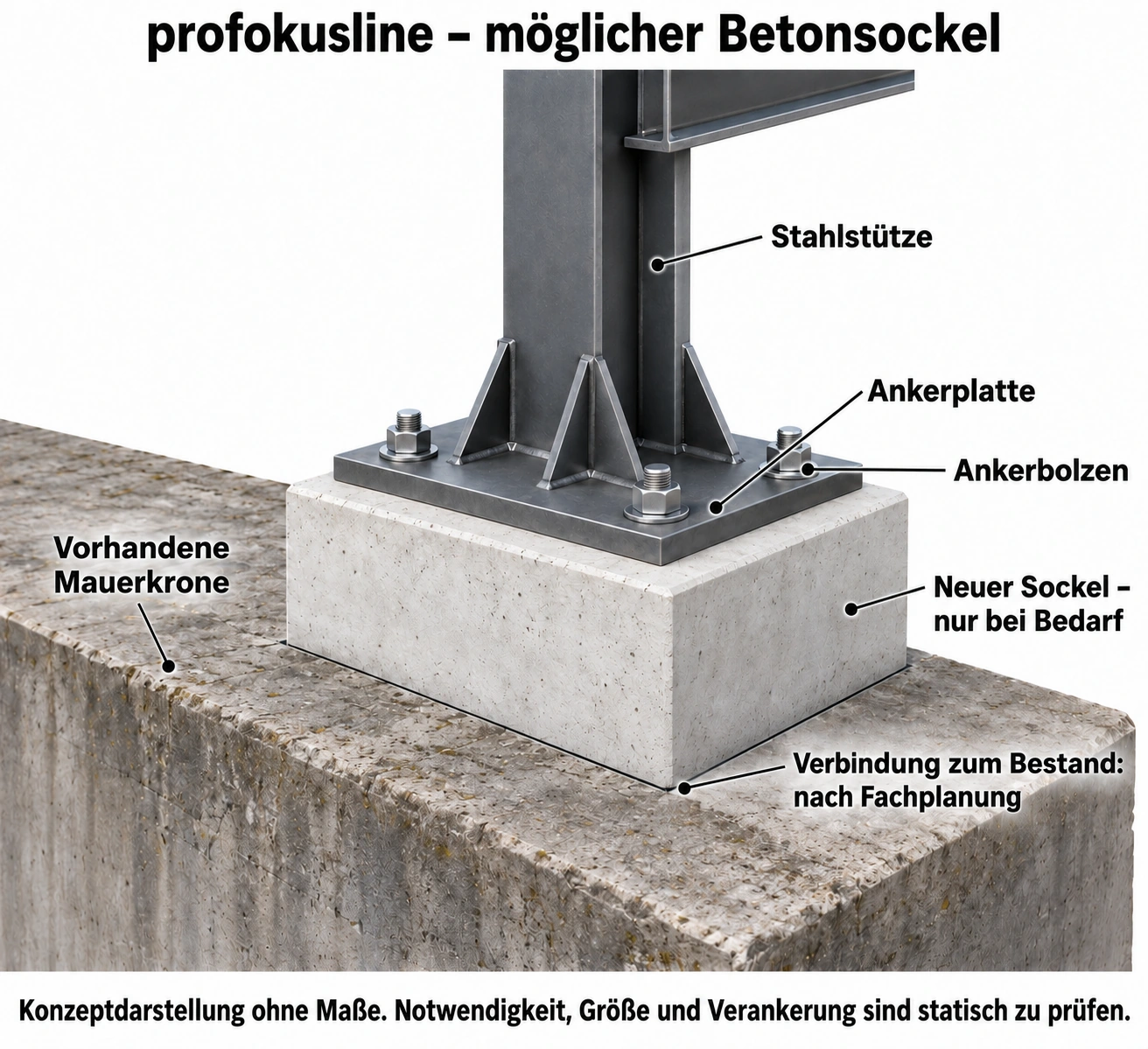
The existing dam remains the basis. An assessment of the structure and structural design determine whether the steel columns can be attached directly or require additional plinths or reinforced supports. A plinth requires an engineered connection to the load-bearing existing structure; the illustration is not an executable anchorage detail.
On the exposed side, a vertical tube is proposed with an upper trolley and a lower guide shoe. Exactly one inspection carriage runs inside it. Spacing, load capacity and guidance must be designed for each structure.
Curved sections and spacers are intended to adapt the tube to concave or convex wall profiles. One internal inspection carriage covers the selected areas; cornering and wall clearance require testing.
Upper and lower guides stabilise the tube along the dam face. Exactly one inspection carriage operates inside the tube. A separate, interchangeable sensor head carries out the water-side cross-check.
A serpentine tube layout (proposed: 150 mm) is intended to cover larger exposed areas. One internal inspection carriage is intended to pass bends up to 90°; prototype testing is required.
When either side detects an unusual feature, the control centre records its position, time and sensor data. A shared origin and surveyed references identify the corresponding inspection area. The opposite unit is then intended to travel to the accessible area and inspect it with its own sensors. This is envisaged in both directions; measurements need not be simultaneous.
Images, readings and inspection conditions are linked to a shared finding record. Later runs are intended to document changes. Position accuracy and repeatability require pilot validation. Inspection of both surfaces alone establishes neither a through-crack nor its depth inside the dam.
The dry-side equipment may include a camera, lighting and suitable distance or other sensor modules. Underwater options include pressure-rated cameras and lighting, and sonar selected for the task. Equipment, working distances and detection performance require application-specific selection and testing. The catamaran concept is considered separately as a supplementary option for larger reservoir areas and the bed.
Development concepts: the support structure, attachment, safe guidance, measurement performance and integration require assessment for the specific dam. profokusline is concept developer and licensor; qualified specialist partners undertake detailed engineering, construction and testing.
Download concept overview (PDF · German)Open PDFWhen one side detects an anomaly, the other unit is intended to move to the corresponding area on the opposite face. The concept calls for shared records of imagery and measurements. Anomalies on both faces alone do not establish a through-crack.
CONTACT
Firma profokusline · Franz Joachim Seidel
profokusline@gmail.com
+49 157 58279363